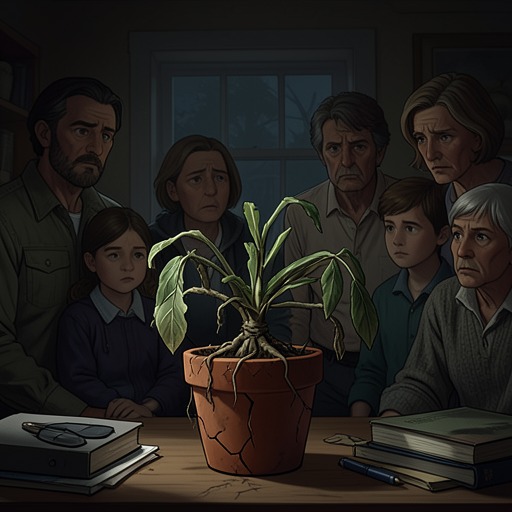
The Lennie houseplant as an emotional barometer
The Sky Is EverywhereThe Lennie houseplant as an emotional barometer is a nondescript indoor plant that Gram has treated as a reflection of Lennie Walker’s emotional, spiritual, and physical well-being. Lennie has come to share that belief. The plant’s changing condition therefore acquires meaning beyond its leaves: it becomes a domestic gauge through which the family registers Lennie’s distress, their own bereavement, and the uncertain return of ordinary life.
A Plant Linked to Lennie
For most of Lennie’s seventeen years, Gram has believed that this particular plant mirrors her granddaughter’s condition, and Lennie says she has grown to believe it too. The relationship is not presented as a botanical fact or as proof that the plant literally responds to Lennie. Rather, their shared interpretation makes the plant part of how the family understands her. Its deterioration is noticed as a possible sign about Lennie, not simply as a problem to solve with gardening.
The plant is already visibly marked when the story introduces it: its leaves have black spots, which Gram and Big discuss, including whether it might recover as it has before. Gram’s question that this time may be different gives the spots a history. The plant has apparently been unwell on earlier occasions, but its present state feels more ominous to her. Lennie’s brief observation that this time is different leaves the connection between plant and person emotionally charged without establishing that either one’s future can be read from the other.
Bereavement Made Visible at Home
The plant’s condition is set beside the family’s loss. Bailey died about a month earlier, collapsing from a fatal arrhythmia during rehearsal for a local production of Romeo & Juliet. Lennie’s opening account places the death alongside her mother’s sixteen-year absence and the family’s changed life since the loss. In this context, Gram’s concern about spotted leaves belongs to a household struggling to find any reassuring sign of recovery. The plant gives that anxiety a visible, familiar object on which to settle.
Gram is known in Clover as a garden expert, with a celebrated flower garden in Northern California and roses reputed in local lore to inspire love. Her skill makes the sick houseplant an instructive contrast: care and horticultural knowledge do not guarantee that this plant will improve. Lennie describes it as following the trajectory of her life independently of Gram’s efforts and of its own apparent plant nature. That comparison conveys the emotional force of the motif while preserving uncertainty about what causes the plant’s condition.
Laughter Changes the Household
When Joe Fontaine visits, he notices the plant on the table and asks about its condition. His question prompts silence, because the family does not know how to explain their identification of the plant with Lennie. Big answers by bluntly equating the two: the plant is dying, and the family does not know what to do about Lennie. The remark breaks the tension. Gram, Big, and Lennie fall into an uncontrolled fit of laughter, the first such episode in months.
The laughter has significance even though the plant has not recovered. Gram calls it Aunt Gooch, the family name for her laugh, which Bailey and Lennie had likened to an unexpected relative who arrives and refuses to leave. Gram’s astonishment that the laugh might have returned underscores how unfamiliar relief has become since Bailey’s death. For a moment, the object associated with Lennie’s distress is also at the center of a shared release. The scene shifts the plant from an emblem of private worry into a focus for the family’s connection, including Joe’s presence in the household.
Care Without a Confirmed Cure
The family continues to watch the plant rather than treating the laughter as evidence that it has improved. On another morning, Big reports that he and Joe thought they saw life in a spider they had been observing, but the apparent movement proves to be a breeze; the spider remains dead, and the Lennie plant is still languishing. Big considers changing his approach and adding ultraviolet light. These details place the plant among the household’s attempts to interpret and respond to fragile signs of life, while making clear that hope and observation do not amount to a cure.
Joe also tries a different intervention, putting the plant beneath one of the pyramids. Big celebrates the idea, but the account offers no result showing that it works. The plant’s condition therefore remains unresolved in the supplied episodes. Its place within this family is not dependent on a successful remedy: it continues to attract their attention because they have made it a way of thinking about Lennie’s welfare.
Meaning of the Motif
The plant’s changing role rests on a contrast between its visible state and the family’s changing capacity to respond. At first, its spots deepen Gram’s worry at a time when the family sits together in grief and feels that its horizon has vanished. Later, the plant is still sickly, but Joe’s question and Big’s answer make the same shared concern briefly comic and communal. The circumstances change; the leaves do not need to improve for the scene to register a human change.
As an emotional barometer, the plant also shows how the family gives form to what it cannot readily explain. Gram’s care, Big’s expertise, and Lennie’s belief all gather around an ordinary household object, yet none provides certainty about Lennie’s inner life or the family’s recovery. The motif holds those limits in view. It makes grief observable without reducing it to a diagnosis, and it allows a small, recurring concern to register both the persistence of sorrow and the possibility of laughter returning alongside it.